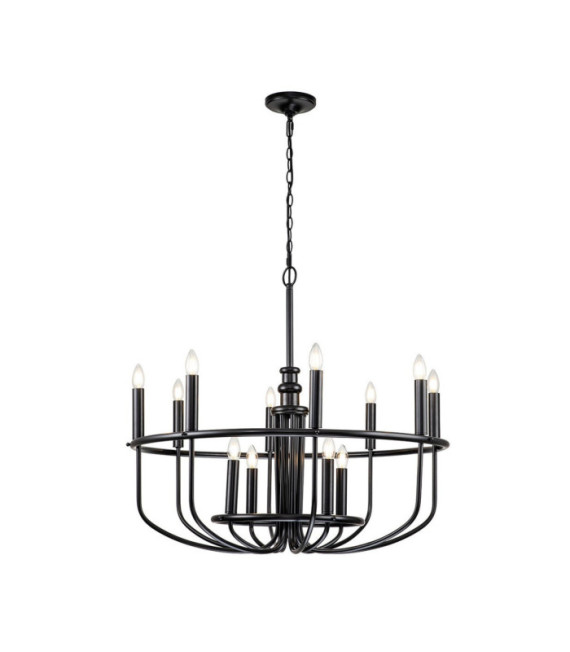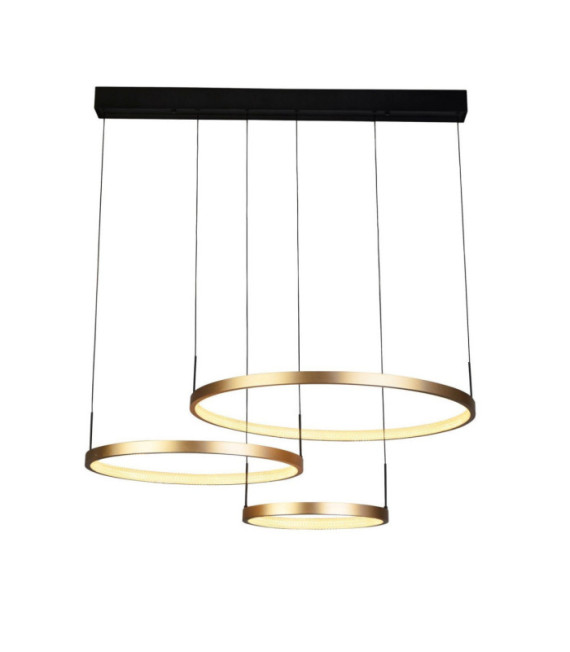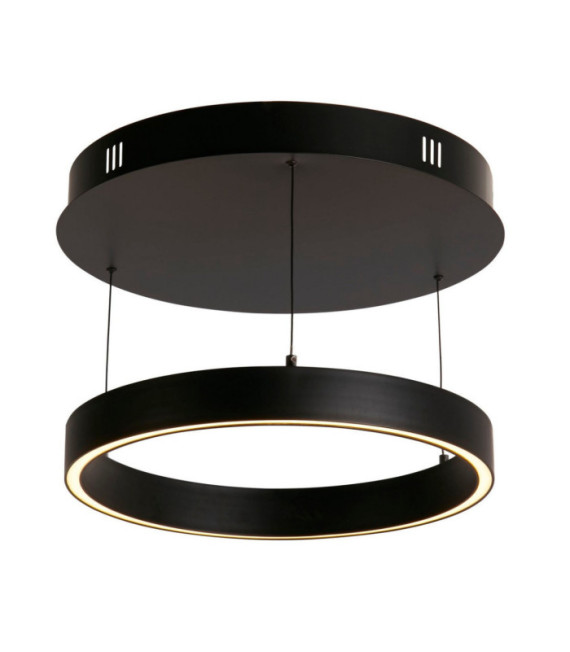
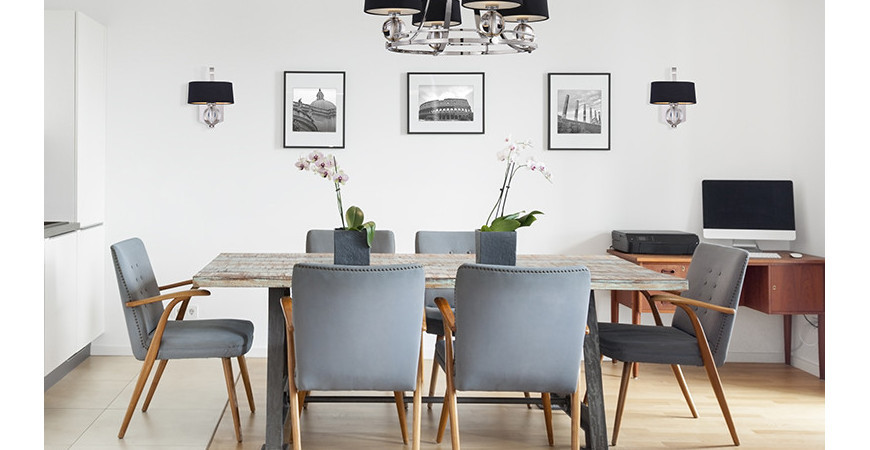
A dining pendant should serve the table, illuminate meals and let people see one another. Start with the furniture you actually use, including extension leaves, rather than the geometric centre of the room.
Record three dimensions
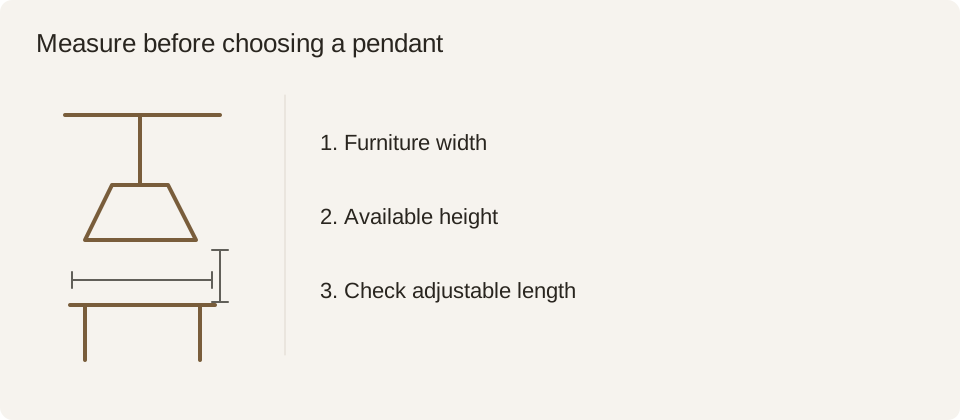
Measure table width and length, then the distance from tabletop to ceiling. Distinguish fitting-body height, cable or rod length and the stated minimum and maximum overall drop. Adjustable must refer to a documented range, not an assumption.
Match the shape
| Table | Options to compare | Check carefully |
|---|---|---|
| Round or square | One centred pendant or a compact cluster | Diameter and views between diners |
| Rectangular | Linear fitting or several light points | Distribution and electrical positions |
| Extendable | Arrangement that works open and closed | Light at the ends |
An example of checking the footprint
With a 90 cm wide table and a 50 cm diameter pendant, a centred arrangement leaves a theoretical 20 cm on each side: (90 − 50) ÷ 2. This checks proportion; it is not a safety clearance or proof of light levels. Check the widest part of the shade too.
Test the height in use
A lightweight cardboard mock-up, without touching the electrical installation, can help you judge the volume. View it seated, standing and from nearby routes. The source should not hide faces or create uncomfortable glare. The final position depends on the fitting, location and instructions.
Compare light, weight and care
Check the number of sources, available lumens, cap type and whether bulbs are included. For crystal chandeliers, allow for weight, cleaning access and a fixing suitable for the support. Ask a professional to confirm fixing and connection. Dimming requires explicit compatibility between source, fitting and control.