
How many recessed spotlights per m²? The sum, room by room
The right number of recessed spotlights comes from lumens and floor area: one 300 to 500 lm downlight per 1 to 1.5 m² in a kitchen, bathroom or hallway, half as many in a living room or bedroom. The sum, room by room, and where to place them.
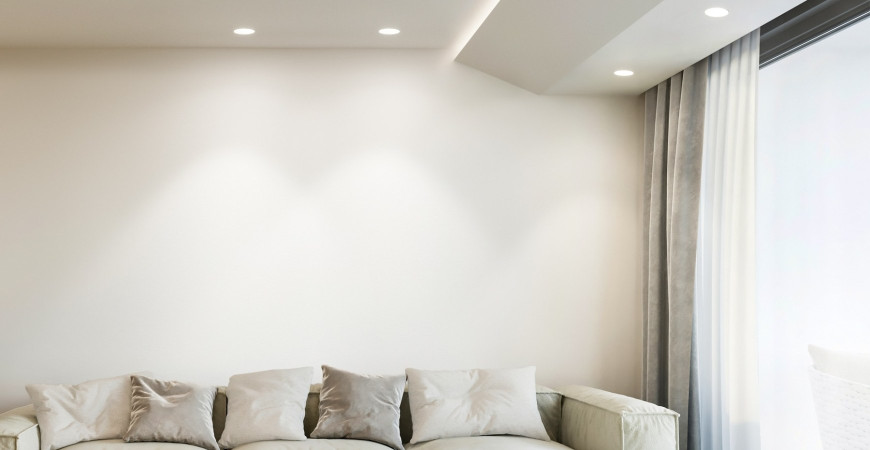
Allow one recessed spotlight, or downlight, of 300 to 500 lm for every 1 to 1.5 m² in a kitchen, bathroom or hallway. In a living room or bedroom the general light needs half as much, so one 300 lm spotlight for every 2 to 3 m². A 12 m² bedroom therefore takes four to six 300 lm spotlights if they light it alone, or three with two bedside lamps. Then set them 1 to 1.5 m apart and 50 cm from the walls.
The sum: lumens per m², divided by the output of one spotlight
It all starts with a division. On top, the light to install: 100 to 150 lm per m² for a living room or bedroom, twice that for a kitchen or bathroom. Underneath, what one spotlight gives, 300 to 500 lm for an everyday model. At 300 lm each, the 200 to 300 lm per m² of a kitchen come to one spotlight per 1 to 1.5 m². That is the usual rule, and it holds for rooms you work in. For a bedroom, the same division gives one per 2 to 3 m².
The total is shared between all the sources in the room. A 300 lm bedside lamp or a 1,500 lm uplighter takes that much off the spotlights. The guide to how many lumens per room says when to take the top of the range.
The output of each spotlight changes the count
A GU10 LED bulb gives 300 to 500 lm, and the choice is yours. On a model with integrated LEDs the output is fixed when you buy and varies widely between spotlights: among LED spotlights, read it on the product page before you count.
For 2,000 to 3,000 lm, what a 20 m² living room needs, you want seven to ten spotlights of 300 lm, five to eight of 400 lm or four to six of 500 lm. To turn them down in the evening, the bulb and the fitting must both be dimmable, and the dimmer an LED model.
The number of spotlights, room by room
| Room | Guide figure | Number of spotlights | Where to put them |
|---|---|---|---|
| 12 m² bedroom | 1,200 to 1,800 lm | Four to six of 300 lm, three with two bedside lamps | In front of the wardrobe, towards the foot of the bed |
| 20 m² living room | 2,000 to 3,000 lm | Five to eight of 400 lm, fewer with a floor lamp | Along a wall, away from the sofa |
| 10 m² kitchen | 2,000 to 3,000 lm | Five to eight of 400 lm, worktop included | Over the worktop first |
| 3 m worktop | One spotlight every 1 to 1.5 m | Two of 500 lm | 50 cm from the wall, in front of the wall cabinets |
| 5 m hallway | Same spacing | Four or five | In one row, the first 50 cm from the door |
| 6 m² bathroom | 1,200 to 1,800 lm | Four to six of 300 lm | IP rating according to the zone |
Living room and bedroom
Here the spotlights provide the background, at 2,700 K, and the lamps do the rest. Turn adjustable models towards a wall, never towards a seat.
Kitchen and hallway
In a kitchen, start with the worktop: a row 50 cm from the wall falls in front of the wall cabinets, over the front of the worktop, and not behind you. Take these kitchen spotlights at 4,000 K, then fill in the ceiling up to the total for the room. A hallway one metre wide makes do with a single centred row, with a wide beam.
Bathroom
Same count as in a kitchen, but the position decides the model. Above the bath or shower tray and in the 60 cm band around it, zones 1 and 2 of BS 7671, you need IPX4 at least, IPX5 where water jets are used; further away, IP44 is still advisable. The zones are drawn out in the guide to lighting a bathroom, and the mirror keeps its two wall lights. In England and Wales a light fitted within the zones is notifiable work under Part P, so leave it to a registered electrician.
Spacing and distance from the walls: 1 to 1.5 m, 50 cm
Along a row, keep 1 to 1.5 m between two spotlights. In front of a wardrobe, the 50 cm is measured from its doors.
In a living room as in a bedroom, do not grid the whole ceiling. Put the rows in front of storage, along a wall or over the walkway, and leave the sofa and the bed to the lamps.
How many spotlights in a 12 m² bedroom?
Three spotlights of 400 lm if the bedroom has two bedside lamps, four to six of 300 lm with no other light. Take a 3 × 4 m room with the bed against a 3 m wall and the wardrobe opposite: 1,200 to 1,800 lm to install.
The bedside lamps, 300 lm each, bring 600. That leaves 600 to 1,200 lm for the ceiling, and three recessed spotlights of 400 lm cover the top of the range. Line them up 50 cm from the wardrobe doors, so towards the foot of the bed, the two end ones 50 cm from the side walls and the middle one 1 m from each of them. The row fits within the 3 m and nothing sits directly above the pillow. Installed total: 1,800 lm.
Shallow ceiling void, insulated ceiling
Above the plasterboard, allow around ten centimetres of void for a GU10 and 3 to 4 cm for a flat LED module; recessed spotlights give recess depth and cut-out diameter on every product page. If the ceiling is insulated, take a model designed to sit in contact with insulation, or fit a protective cover over it. Under another room or a loft, ask your electrician what the Building Regulations require of a downlight.
With no void at all, the count stays the same with surface-mounted or track spotlights. To choose between recessed and surface-mounted by ceiling height, see the guide to lighting small spaces.
The counting mistakes we see most often
- Counting by floor area without looking at the output. Ten spotlights of 500 lm in a 12 m² bedroom make 5,000 lm, nearly three times what the room needs.
- Centring the row in the kitchen. As soon as you face the worktop, the spotlights are behind your back.
- Applying the kitchen rule to the living room, which gives twice as many spotlights as the room needs.
- A spotlight above the head of the bed. Lying down, you look at the ceiling; its place is towards the foot of the bed or along the wardrobe.