
How many lumens per room? The calculation method
Allow 100 to 150 lumens per m² in a living room or bedroom. Kitchens and bathrooms need 200 to 300; share the total over two or three lights, so a 25 m² room takes 2,500 to 3,750 lumens, worked through below.
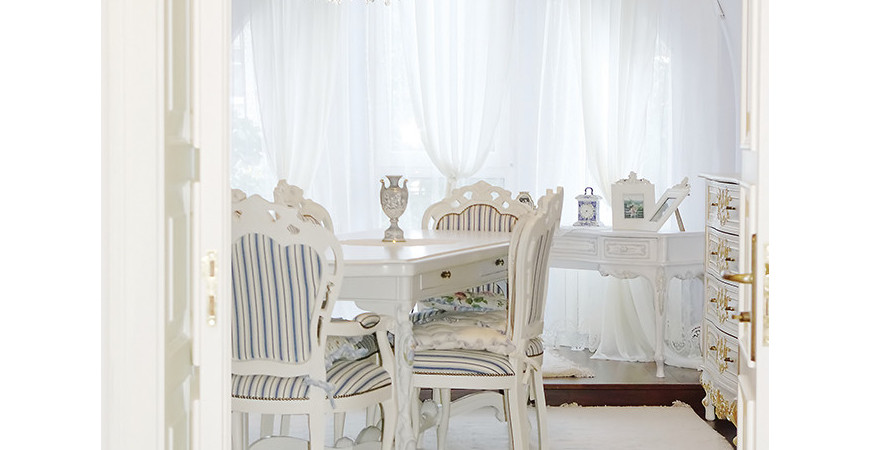
The result of the sum is a total to share out, not the output of one fitting. A 1,600 lumen ceiling light, a 500 lumen reading lamp and a 400 lumen lamp on a sideboard make 2,500 lumens, the bottom of the range for a 25 m² living room. Desks and worktops escape the per-m² rule. There you aim for 300 to 500 lux on the working surface, with a directed lamp.
What lumens, lux and watts measure
Lumens measure what the source gives out; the figure appears on the bulb packaging or on the product page of an integrated-LED fitting. Lux measure what lands on a surface, one lux being one lumen per m², and they drop fast as the source moves away. That is the quantity that matters on a sheet of paper.
Since LEDs arrived, watts say nothing about light, only about consumption. A 5 to 6 W LED puts out roughly 470 lumens (an old 40 W), 8 to 10 W around 800 (an old 60 W), and 12 to 15 W about 1,500 (an old 100 W). The guide to LED bulbs by room goes through caps and equivalents.
The figure for each room, and why it’s a range
| Room | Light to install | Example |
|---|---|---|
| Living room, bedroom | 100 to 150 lumens per m² | for 20 m², 2,000 to 3,000 lumens |
| Kitchen, bathroom | 200 to 300 lumens per m² | for 10 m², 2,000 to 3,000 lumens |
| Study, worktop | 300 to 500 lux on the working surface | a directed lamp of 400 to 800 lumens |
| Hallway, entrance | per fitting, not per m² | a wall light of 300 to 500 lumens every 2 to 3 m |
Take the bottom of the range when the ceiling is white, the walls are pale and the room is meant for relaxing. Move towards the top when the walls are dark, when the room faces north or when people read there. A charcoal wall returns very little of what it receives, and the installed total has to make up for it. Colour temperature plays no part in the sum: 2,700 K in living rooms and bedrooms, 3,000 K in kitchens, dining rooms and hallways, 4,000 K for the desk, the worktop and the mirror.
Sharing the total over two or three layers
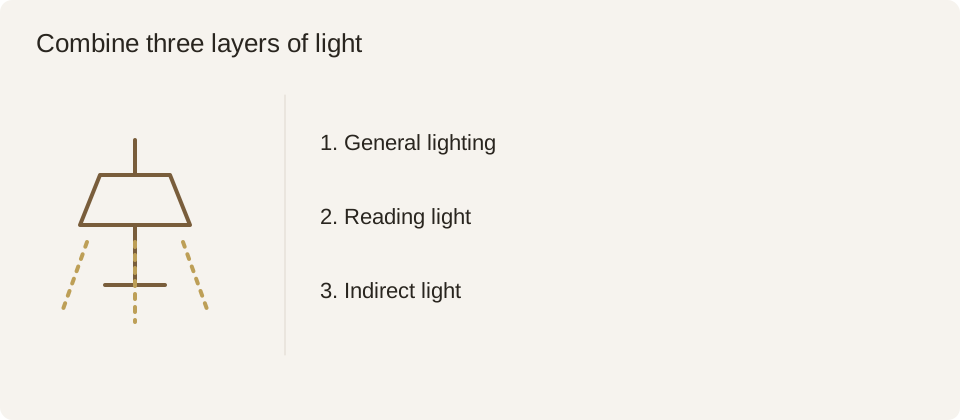
A single 3,000 lumen ceiling light in the middle of a 20 m² living room gives the correct total and poor lighting. The centre is bright. The armchair stays in shadow. Split the same total between general, task and mood lighting and you can adjust it to the time of day. Typical figures per fitting help you carve it up.
- A ceiling light or pendant lighting a room of 15 to 20 m² on its own gives about 3,000 lumens; over a table for six, 1,500 to 2,000 lumens in total.
- An uplighter floor lamp, bouncing light off the ceiling, gives 1,500 to 3,000 lumens; a mood floor lamp, 800 to 1,500.
- A reading light by an armchair, bed or desk gives 400 to 800 lumens in a directed beam.
- A table lamp used as an accent gives 300 to 600 lumens, a mood wall light 300 to 500.
- A recessed spotlight gives 300 to 500 lumens, one per 1 to 1.5 m² of worktop or hallway.
In a living room the general light carries the biggest share and the lamps split the rest; in a kitchen, worktop spotlights take a much larger slice. With no ceiling rose, the general layer comes from an uplighter, as set out in the guide to lighting a room without a ceiling light.
Worked example: a 25 m² living room with a 2.50 m ceiling
A 5 × 5 m room with pale walls, a sofa facing the window, a reading chair in the corner and a sideboard. The sum gives 2,500 to 3,750 lumens, and with pale walls we aim for about 3,000. General light comes from a short living room pendant. Under a 2.50 m ceiling, a 40 cm drop leaves 2.10 m of headroom, and the diameter follows the (length + width) × 8 rule, giving 80 cm. Three dimmable 2,700 K E27 LED bulbs of 800 lumens make 2,400 lumens, where you once needed three old 60 W bulbs.
Reading falls to a 500 lumen reading floor lamp behind the chair, its source slightly above and behind your shoulder when seated. A 400 lumen table lamp on the sideboard completes the count: 3,300 lumens installed, within the range. In the evening the pendant is dimmed to a third and both lamps stay on.
Variations: a 12 m² bedroom and a 10 m² kitchen
In a 12 m² bedroom the same reasoning gives 1,200 to 1,800 lumens: a 1,200 lumen ceiling light and two 300 lumen bedside lamps, the bottom of each shade at chin height when you sit up in bed. In a 10 m² kitchen you start from 2,000 to 3,000 lumens, including 300 to 500 per spotlight over the worktop, one for every 1 to 1.5 m² of worktop, at 4,000 K over the working area.
The commonest calculation mistakes
Buying in watts. People still ask us for “the equivalent of a 60 W”; the answer is 800 lumens, and a 9 W LED is no feeble bulb.
Putting everything on the ceiling. One central point leaves the corners dark, and a clear bulb visible over the table dazzles. It needs a dimmer and 400 lumens at most; above that, you want an opaque shade or a diffuser.
Reading only half the product page of an integrated-LED fitting. Output is given in lumens, but the module can’t be replaced, so the stated lifespan, typically 15,000 to 30,000 hours, matters as much as the lumen figure.
Treating a bathroom like a bedroom. It needs 200 to 300 lumens per m², and the mirror needs its two sources of 500 to 800 lumens at eye level, 1.55 to 1.65 m from the floor, at 4,000 K with a CRI of 90 or more.
Models to compare
Lighting by room →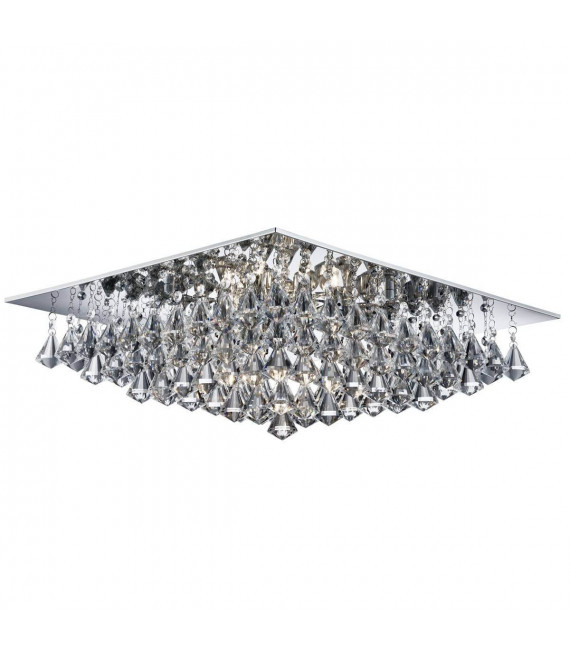
Large Square Ceiling Light Hanna 8 Lights, Pyramid Crystal, 55 cm
In stock
£275
- Height (cm)
- 22
- Width (cm)
- 55
- Bulbs included
- No
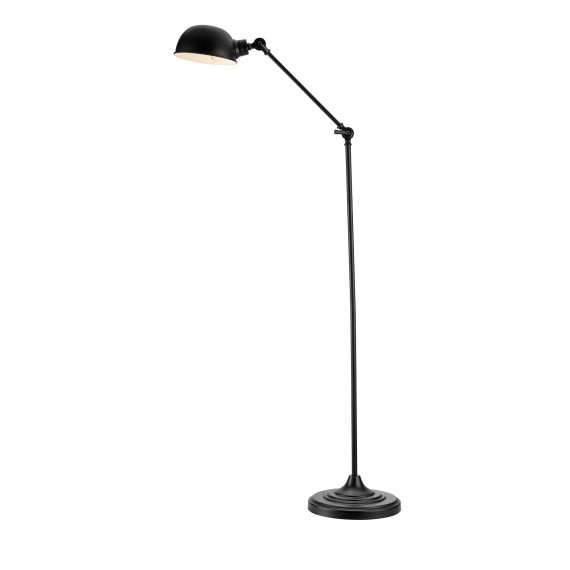
Portland black floor lamp with articulated arm and dome, 143 cm
In stock
£158
- Height (cm)
- 143
- Width (cm)
- 26
- Depth (cm)
- 74.5
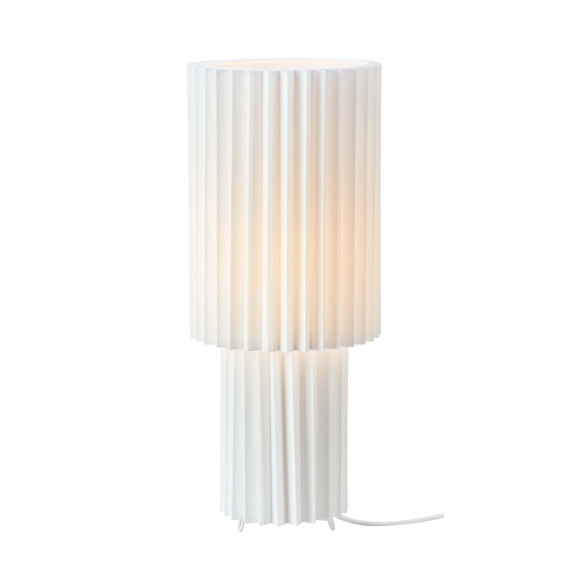
Catis table lamp, white pleated column, 45 cm
In stock
£69
- Height (cm)
- 45
- Bulbs included
- No
- Colour / finish
- White