
What size ceiling light do I need? Diameter, room by room
The diameter of a ceiling light can be worked out: length plus width of the room in metres, times 8, gives centimetres. That means 55 cm for a 3 × 4 m bedroom and 70 cm for a 4 × 5 m living room. Here is the room-by-room table, along with lumens and depth under a low ceiling.
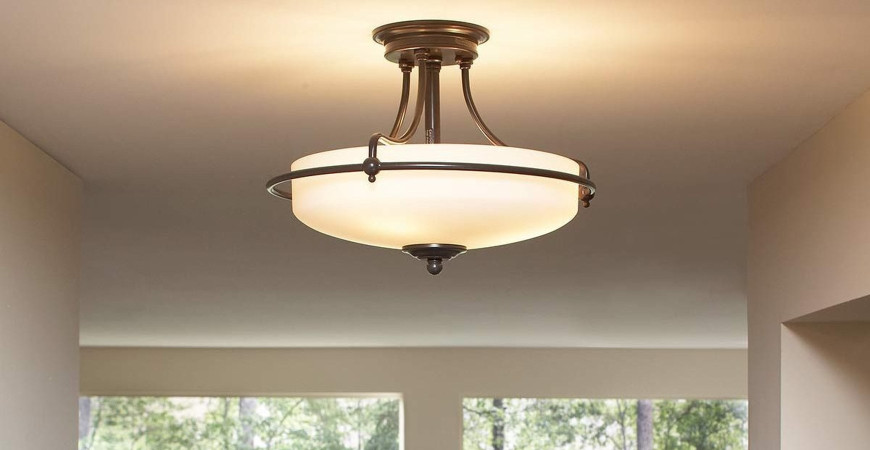
Working out the diameter of a ceiling light takes ten seconds: add the length and width of the room in metres, multiply by 8, and the answer is in centimetres. A 3 × 4 m bedroom calls for a fitting of about 55 cm, a 4 × 5 m living room for one close to 70 cm. That leaves two things to check before you order: the output in lumens, and how deep a fitting your ceiling will take.
The diameter rule: length plus width, times 8
The formula works for a roughly rectangular room lit from a single point in the middle. It gives you a ballpark figure. Between 52 and 56 cm, pick the one you like; nobody will spot the difference. What it does is steer you clear of the two commonest mistakes: the little 30 cm globe marooned in the middle of a living room, and the great disc bearing down on a 9 m² bedroom.
The table applies the rule to the rooms that come up most often, with the light output to allow for each.
| Room | Ceiling light diameter | Output for the room |
|---|---|---|
| Entrance hall, 2 × 3 m | 40 cm | 600 to 900 lm |
| Bathroom, 2 × 3 m | 40 cm | 1,200 to 1,800 lm |
| Small bedroom, 3 × 3 m | 45 to 50 cm | 900 to 1,350 lm |
| Bedroom, 3 × 4 m | 55 cm | 1,200 to 1,800 lm |
| Kitchen, 3 × 4 m | 55 cm | 2,400 to 3,600 lm |
| Living room, 4 × 5 m | 70 cm | 2,000 to 3,000 lm |
| Large living room, 5 × 5 m | 80 cm | 2,500 to 3,750 lm |
The output shown is for the whole room, every light source included. The ceiling light doesn’t have to supply it all.
How many lumens should a ceiling light give?
Allow 100 to 150 lm per m² in a living room, bedroom or entrance hall, and 200 to 300 in a kitchen or bathroom. A ceiling light that is the only light in a room of 15 to 20 m² needs somewhere around 3,000 lm. Add a floor lamp or some table lamps and it can come down. In a 25 m² living room, a ceiling light of 2,500 to 3,000 lm, a 1,500 lm uplighter floor lamp and a lamp on a cabinet do a better job than one very powerful disc on its own. Our guide to how many lumens per room explains how to share it out.
With a fitting that takes bulbs, do the sums before you buy. A 12 to 15 W LED gives about 1,500 lm. So two or three E27 bulbs will reach the output a living room needs; a single E14 never will. On an LED ceiling light with a built-in module, the output is stated on the product page and is there for good, which makes it the first figure to read.
How deep a fitting under a low ceiling?
Anywhere people walk, you need 2 m of clearance beneath the light, 2.10 m to be on the safe side. The maximum depth is a simple subtraction: ceiling height minus 2.10 m.
| Ceiling height | Maximum depth | What fits |
|---|---|---|
| 2.20 m | 10 cm | Ultra-slim fitting with integrated LED |
| 2.30 m | 20 cm | Flat ceiling light with an opal diffuser |
| 2.40 m | 30 cm | Flush ceiling light, glass drum |
| 2.50 m | 40 cm | Ceiling light on a short stem, or a short pendant |
Below 2.40 m, look at the diffuser as well. A bare 2,000 lm LED disc dazzles the moment you glance up, and glass that is too thin is hardly kinder to anyone sitting down. An opal diffuser across the whole face settles the matter. Over a bed, where you look at the ceiling light lying down, choose an enclosed one.
A worked example: a 3 × 3 m bedroom with a 2.30 m ceiling
A child’s bedroom of 9 m², ceiling point in the centre, ceiling at 2.30 m. Diameter first: (3 + 3) × 8 = 48, so a fitting of 45 to 50 cm. Then output: 9 m² at 100 to 150 lm, which makes 900 to 1,350 lm, in 2,700 K. Lastly depth: 2.30 m minus 2.10 m leaves 20 cm.
The shortlist more or less writes itself. You are left with a flat bedroom ceiling light of 45 to 50 cm, with an enclosed diffuser and around 1,200 lm, on a dimmer if anyone reads there in the evening. With a 300 lm bedside lamp alongside, it can sit at the bottom of the range.
Hallways, tables, L-shaped rooms: where the formula runs out
In a hallway or a very long room, one big central ceiling light leaves both ends in shadow. Better to fit a light every 2 to 3 m, using 25 to 35 cm fittings if the passage is 1 m wide.
Over a table, you stop thinking about the room and start thinking about the tabletop. This is pendant territory: a diameter between half and two-thirds of the table’s width, with the bottom of the pendant 70 to 80 cm above the top. Our guide to lighting the dining room covers the ground.
An L-shaped kitchen or a through living room falls outside the rule too. Have the room’s dimensions to hand and ring +33 1 84 20 32 51: we’ll check the diameter and output, Monday to Friday, 9 am to 6 pm Paris time.
The sizing mistakes we see most
- A 30 cm two-bulb ceiling light in a 20 m² living room; it is less than half the diameter required and nowhere near the 3,000 lm needed.
- A 60 cm fitting in a 3 × 3 m room, where the formula says 48; it overpowers the room the minute you walk in.
- Exposed bulbs under a 2.20 m ceiling; the light sources sit in the eyeline of anyone standing up.
- A diameter judged from the photo; with no furniture beside them, a 40 cm disc and an 80 cm one look alike. The measurement is on the product page.
All our ceiling lights are in one section; designer ceiling lights and living room ceiling lights each have their own. For a really low ceiling, our guide to lighting a small room picks up from here.
For the rest of the house, try the other sections: pendant lights, chandeliers, wall lights, table lamps, floor lamps and spotlights.