
How many wall lights per room, and how bright?
One wall light of 300 to 500 lm every 2 to 3 m in a hallway, two in the living room alongside the ceiling light, two by the bed and at the mirror. Number, output and height, position by position.
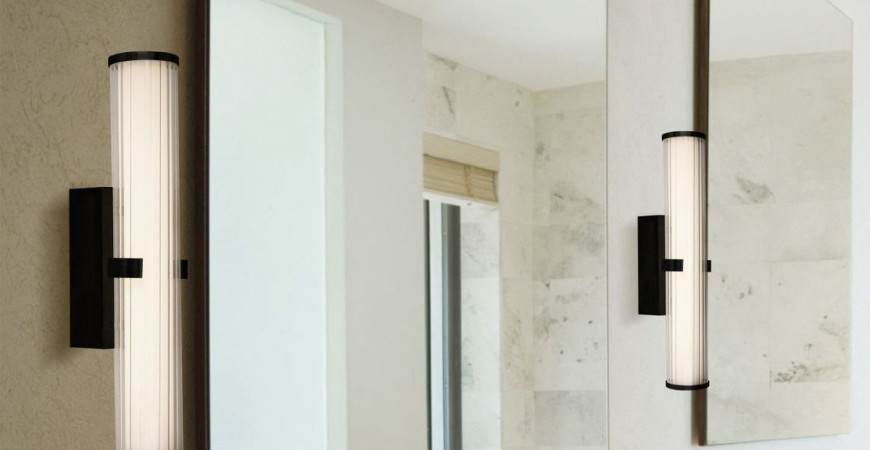
In a hallway, allow one wall light every 2 to 3 m, each giving 300 to 500 lm. In the living room, two wall lights of that output will light the walls but won’t stand in for the ceiling light. By the bed and at the mirror, they always come in pairs. So the number depends less on floor area than on the job you give them: marking the way, backing up other lights or lighting the room alone.
How many wall lights, position by position
| Position | Number and output | Height of centre |
|---|---|---|
| Hallway, 6 m long | 3 wall lights of 300 to 500 lm, one every 2 to 3 m | 1.60 to 1.80 m |
| Staircase | 1 wall light of 300 to 500 lm for every 2 to 3 m of flight, 1 per landing | 1.60 to 1.80 m above the treads |
| Living room, 20 m² | 2 wall lights of 300 to 500 lm, on top of the ceiling light | 1.60 to 1.80 m |
| Bedhead | 2 wall lights of 400 to 800 lm, one per sleeper | 1.10 to 1.30 m |
| Mirror, bathroom or entrance hall | 2 wall lights of 500 to 800 lm, one either side | 1.55 to 1.65 m |
| Bedroom, 12 m², no ceiling light | 2 diffusing globes of 800 lm | 1.60 to 1.80 m |
Heights are measured to the centre of the wall light. Our guide on what height to fit a wall light goes through them one by one, wiring included.
Doing the sums when wall lights are the only lighting
Start with the output the room needs, 100 to 150 lm per m² for a hallway, living room or bedroom, and divide by the output of one wall light. A hallway 6 m by 0.90 m comes to 5.4 m², so 540 to 810 lm. Division alone would give two 300 lm wall lights. Spacing is what pushes it up to three: leave more than 3 m between two points and you get a pool of shadow. The 900 lm you end up with is a little over the range, which a windowless hallway can easily take.
In a living space, the sums soon break down. A 20 m² living room needs 2,000 to 3,000 lm. At 400 lm apiece you would need five to eight wall lights, and nobody wants a wall that looks like a waiting room. Two wall lights supply 600 to 1,000 lm of the total there and leave the rest to the ceiling light and the lamps.
There is one exception: the small bedroom. Two opal globes of 800 lm in 2,700 K are enough for 12 m², provided you pick a design that diffuses the light instead of throwing a directed beam.
How bright should a wall light be?
Three bands are all you need to find your way around. From 300 to 500 lm, a wall light plays a supporting role: it lights its own wall, marks a route, softens a living room in the evening. Up to 800 lm, it is good for reading in bed or for lighting a stretch of hallway single-handed. For reference, 800 lm is what an old 60 W bulb used to give, and what an 8 to 10 W LED gives today.
At the mirror, go for two wall lights of 500 to 800 lm in 4,000 K with a CRI of at least 90, so you see a face without shadows. In a bathroom the IP rating comes into it too: our guide on which bathroom wall light to choose takes it zone by zone.
As for colour temperature, 2,700 K in the living room and bedroom, 3,000 K in a hallway. Stick to one value per room.
Spacing, and the gap below the ceiling
Two to three metres between wall lights, in a hallway and a stairwell alike. A half landing earns a light of its own. Either side of a mirror or a bed, the furniture sets the gap.
A wall light that shines upwards needs 60 to 80 cm between its top and the ceiling, otherwise all it does is paint a blotch up there. Under a 2.30 m ceiling, then, its top sits between 1.50 and 1.70 m. In a passage less than a metre wide, keep the projection under 10 cm: coats catch on it less.
A worked example: a 4 × 5 m living room with a 2 m sofa
A 20 m² living room, 2.50 m ceiling, sofa against the long wall. The target is 2,000 to 3,000 lm. The ceiling light gives 1,500 of that, on a dimmer. Two 400 lm living room wall lights flank the sofa, centres at 1.70 m, in 2,700 K. A 400 lm table lamp on the sideboard rounds things off. That makes 2,700 lm in all, and you never have the lot on at once.
In the evening, with the ceiling light off, the two wall lights and the lamp put 1,200 lm on the walls. It’s not much to hoover by, and it’s what you want for a film. If there is no cable in the wall at that spot, plug-in versions with a lead run to the nearest socket, under a cable cover.
The most common miscounts
- Two 300 lm wall lights as the only light in a living room; three-quarters of the output is missing.
- A single wall light above the mirror; it deepens the shadows under the eyes, where two at the sides wipe them out.
- A single point halfway along a 6 m hallway; both ends stay gloomy.
- An upward-facing wall light 30 cm from the ceiling; all it lights is a patch.
- A backplate too small to replace an old wall light; it has to be at least 8 cm to cover the back box.
All our wall lights are in one section. Designer wall lights, those for hallways and entrances and bedroom wall lights each have their own.
For what wall lights can’t do, look to the other sections: ceiling lights, pendant lights, chandeliers, table lamps, floor lamps and spotlights.