
Lighting a toilet, a cloakroom and small passageways
A toilet needs one 300 to 500 lm light in warm white, and nothing more. A short passage takes a wall light every 2 to 3 m, and a presence sensor helps wherever lights get left on.
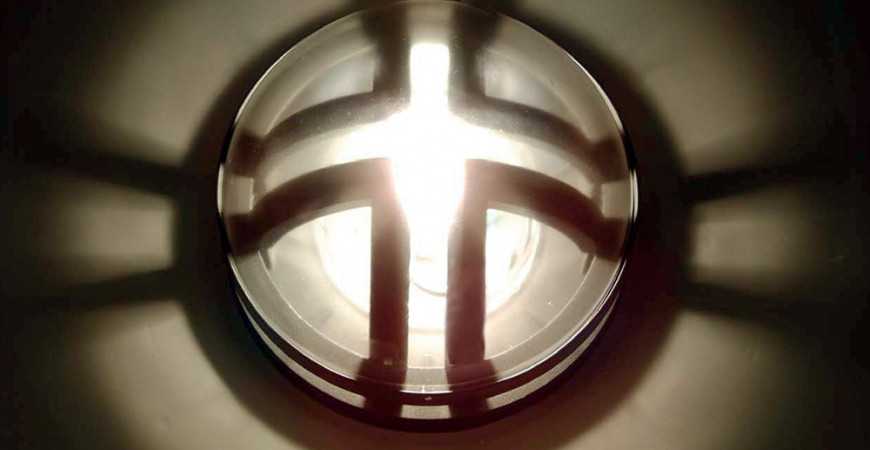
For 1 to 2 m², don’t bother calculating per square metre. One source of 300 to 500 lm lights the toilet, the handbasin and the loo roll; that is a 5 to 6 W LED bulb, the equivalent of an old 40 W. Choose warm white, 2,700 or 3,000 K to match the hallway outside, and a closed diffuser. In an inner hall or a lobby, the hallway rule applies over a shorter distance: a wall light 1.60 to 1.80 m up every 2 to 3 m, or one spotlight per 1 to 1.5 m². Where the wiring comes out, ceiling or wall, decides between a ceiling light and a wall light. A presence sensor is the purchase that changes most in these spaces.
A toilet needs one light of 300 to 500 lm
Go brighter and the white walls and tiles bounce it all back into your eyes. Never 4,000 K either, because the step from a warm hallway to a neutral-white cloakroom shows every time the door opens. In a space 1 m wide the bulb is always in view, so use opal glass or closed metal, with no bare filament.
Compact ceiling light or wall light?
A compact ceiling light wins when the wiring comes out of the ceiling. The diameter rule gives (1 + 1.5) × 8 = 20 cm for a 1 × 1.5 m toilet; aim for 20 to 30 cm, as flat as you can find. A wall light takes over when the wiring comes out of the wall, above the door or opposite it, 1.60 to 1.80 m above the floor. Where the space is under 1 m wide, keep the projection under 10 cm or shoulders will knock it. Compact hallway ceiling lights and slim hallway wall lights cover both cases.
Does a toilet need an IP rating?
No, apart from special cases. BS 7671 bathroom zones relate to the bath and the shower; a handbasin creates none, and IP20 is acceptable. In a windowless cloakroom where condensation settles, IP44 is a comfort, not a requirement.
A presence sensor, placed where it can see the door
In a toilet, people switch on with their hands full and forget to switch off. The sensor can be built into the ceiling light or take the place of the wall switch. Its range on paper hardly matters: it has to see the door open and the toilet itself, not just the middle of the ceiling. Place it facing the door, never behind it as it swings. Set the time delay to a few minutes, and prefer a presence detector, which picks up small movements, to a basic motion sensor that switches off while you are sitting down. Check that it is rated for LEDs. Some sensors, like dimmers, need a minimum load that one small LED bulb may not reach.
Inner hall, landing or porch: the hallway rule, shortened
A 1 × 3 m inner hall between bedrooms works like a short hallway. One wall light in the middle, 1.60 to 1.80 m up and 300 to 500 lm, lights all three doors; beyond 3 m, add a second one 2 to 3 m from the first. On the ceiling, fit hallway spotlights at one per 1 to 1.5 m², 300 to 500 lm each and 50 cm from the walls, which means two or three for 3 m², or a single compact ceiling light in the centre. Throughout, 3,000 K like the rest of the circulation space.
A 2 m² porch is the exception: treat it like the entrance hall it leads into, with the heights given in the guide to lighting an entrance hall. A landing sees the staircase go by. Light must fall on the top step, not in the eyes of whoever is climbing, with two-way switching at the top and bottom; stairs have their own section in the guide to lighting a hallway and staircase. Wall lights, compact ceiling lights and spotlights are all listed under hallway lighting.
Cupboards, utility rooms and other corners
A utility room or broom cupboard also gets by on 300 to 500 lm, but this time at 4,000 K. You go in to read a label, not to unwind. A compact ceiling light with a sensor, or an LED strip light above the door that comes on as it opens, ends the groping for a switch. A closed diffuser wipes clean in seconds; add IP44 if the room is damp. Garages and cellars count as technical lighting, with a sealed LED batten in cool white of 5,000 K or more, and fall outside this guide.
Worked example: a 1 × 1.5 m toilet at the end of a 3 m inner hall
A 1 × 3 m inner hall serves two bedrooms and a 1 × 1.5 m toilet at the far end, with 2.50 m ceilings, no window and one ceiling rose in each space. In the toilet, a 20 cm compact ceiling light with an opal diffuser, 300 to 500 lm at 3,000 K, with a built-in sensor set to a few minutes. In the hall, three ceiling spotlights in a line, 300 to 500 lm each, 1 m apart and 50 cm from the end walls, at 3,000 K, run by a sensor in the middle of the ceiling that can see all three doors. Total for 4.5 m²: 1,200 to 2,000 lm, none of it left burning once everyone is in bed.
No ceiling rose in the hall? Two plug-in wall lights at 1.70 m, 2 m apart, with the flex hidden under a slim cable cover.
Small spaces badly lit, and why
- A 1,000 lm ceiling light in 1.5 m² of white tiles. You are dazzled on every visit; fit 300 to 500 lm and a closed diffuser.
- 4,000 K in the toilet at the end of a 3,000 K hallway. Two whites one door apart, when the hallway’s colour would do.
- A sensor hidden by the open door. It sees nobody come in and switches off while you sit; put it facing the door, with the toilet in view.
- A wall light that sticks out into a 90 cm passage. Everything catches on it, so keep the projection under 10 cm wherever the width is under 1 m.
Models to compare
Hallway lighting →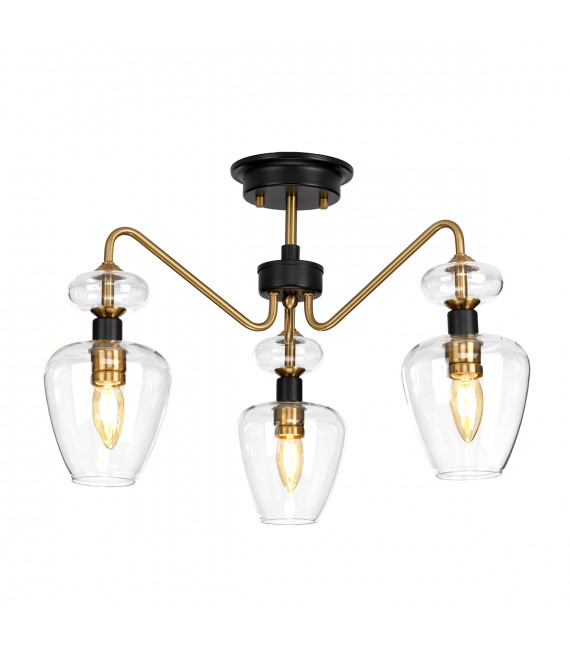
Armand 3-light brass and black ceiling light, clear glass tulip shades
In stock
£255
- Height (cm)
- 36.2
- Bulbs included
- No
- Colour / finish
- Aged brass plated and charcoal black paint
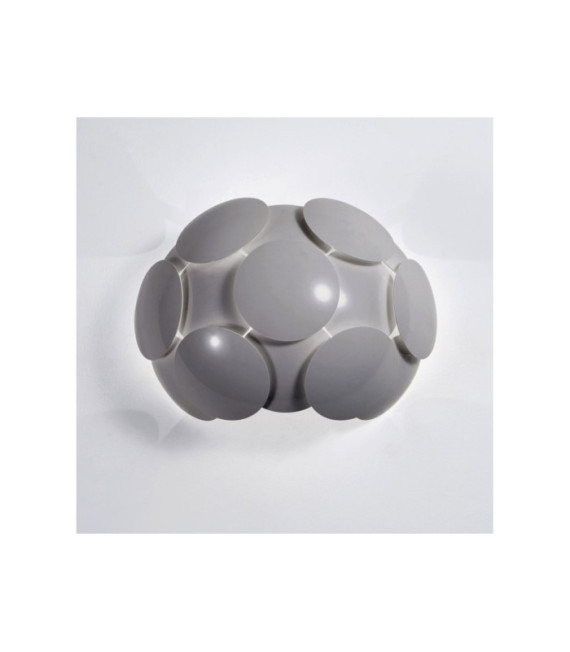
Santina grey wall light with overlapping discs, large size, E27
In stock
£44
- Height (cm)
- 27
- Width (cm)
- 18
- Bulbs included
- No
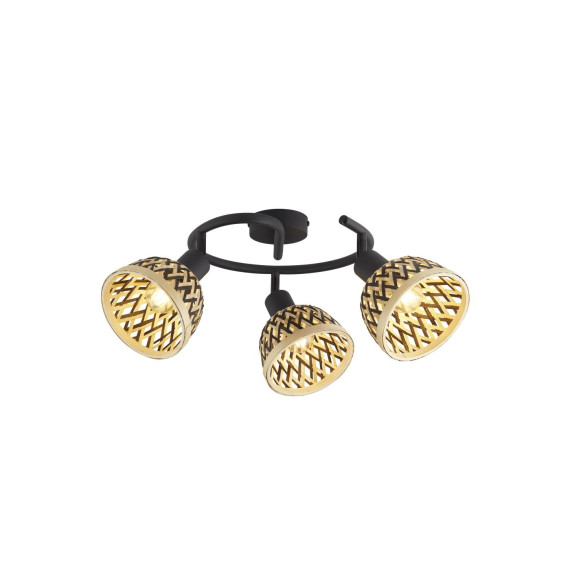
Lance 3-light spotlight on black ring, woven bamboo shades, E14
In stock
£77
- Height (cm)
- 17
- Width (cm)
- 46
- Bulbs included
- No