
Lighting a shelf, a display cabinet or a sculpture without reflections
An object stands out when its light is far stronger than the room’s. It has to arrive at an angle and never show in the glass, so set three things: the beam, the angle and the colour, with CRI 90 LEDs.
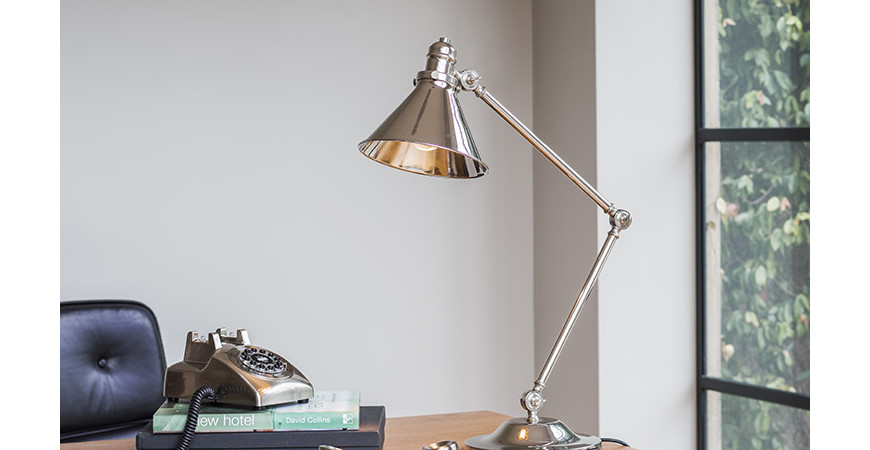
To light up a shelf, a display cabinet or a sculpture, work with an adjustable spotlight or LED strip, in warm white of 2,700 to 3,000 K and with a colour rendering index of at least 90. The light should arrive at an angle, about 30° from vertical, and be clearly brighter than the room’s general lighting. Accent light only exists through contrast. If the ceiling light gives the same level everywhere, the spotlight achieves nothing.
Contrast first: the accent must outshine the background
Lighting designers commonly work to a ratio of three to five, meaning the object gets three to five times more light than its surroundings. Beyond that the effect turns theatrical, which suits a sculpture but not a bookcase. In a living room lit at 100 to 150 lumens per m², a spotlight of 300 to 500 lumens focused on a square metre of shelving is enough to create that gap. The circuit matters as much as the spotlight. Give the accent its own switch or switched socket, so it can come on alone in the evening while the ceiling light is off or dimmed.
Shelves and bookcases: from the ceiling or under each shelf
From the ceiling, one adjustable spotlight per bay of shelving washes the book spines with a wide beam. Its distance from the wall follows from the 30° angle: a little over half the height between the ceiling and the middle of the shelves, so 75 cm from the wall for a 2.50 m ceiling and a shelf centre at 1.20 m. Too close to the wall and only the top shelves get any light. Too far, and the light hits flat and glossy spines throw a reflection back. A plate of two or three ceiling spotlights fits to an existing ceiling rose with nothing recessed, provided the rose sits at the correct distance from the wall, which often means having a new one run. Adjustable recessed spotlights also need a ceiling void above.
Under each shelf, an LED strip in a profile with an opal diffuser, hidden behind the front lip of the shelf, lights the objects below without casting shadows on the back panel. Use the same colour as the rest of the living room, 2,700 K, and CRI 90 if the colours of the objects matter. A strip can be cut to length, but its driver has to go somewhere, behind the unit or in the plinth.
Display cabinets: never see the lamp in the glass
Glass reflects anything brighter than itself, the lamp as well as the window opposite. There are two ways round it. Either the source goes inside, with vertical strips along the uprights or small spots in the top panel, and the cabinet becomes the light fitting. Or the source stays outside, on the ceiling, out of the line of sight and never facing the glass.
A glass shelf lit from its edge glows across its whole surface. Crystal, with its higher refractive index, bends light more strongly, so a decanter lit from below sparkles where an ordinary glass simply stays clear. In a closed cabinet, keep to a low-output strip; an LED runs cool, but a sealed space holds on to heat.
Sculpture: a narrow beam, from the side, never head-on
A sculpture needs shadows for its relief to show. Light from the front flattens them, whereas light at an angle, 30° from vertical and offset to one side, models the forms. An adjustable spotlight with a narrow beam suits a piece 30 to 50 cm tall; a life-size bust needs a medium beam, and two crossed spotlights soften a shadow that is too harsh.
For a sculpture centred 1.50 m from the floor under a 2.50 m ceiling, fix the spotlight 55 to 60 cm from the wall. Never use cool white on stone or bronze. Artworks stay at 2,700 to 3,000 K, and the beam must never end on a seat. Adjustable living room spotlights can be re-aimed by hand after fitting, which helps when the object moves.
Worked example: a 2.40 m bookcase in a 4 × 5 m living room
A 20 m² living room with a 2.50 m ceiling, and a bookcase 2.40 m wide and 2 m high, in three bays against the end wall, with two niches holding a ceramic piece and a 40 cm bronze. The general lighting gives 2,000 to 3,000 lumens at 2,700 K on a dimmer, as lighting a living room requires. For the bookcase, a bar of three adjustable spotlights is fixed to the ceiling 75 cm from the wall, wired from a new supply run to that spot: one spotlight per bay, 300 to 500 lumens each, wide beam, 2,700 K, CRI 90. The middle one switches to a narrow beam and picks out the bronze’s niche from the side.
In the evening, with the ceiling light down to a third and the spotlights on, the bookcase receives 900 to 1,500 lumens across 2.40 m and becomes the bright backdrop of the room. Ceiling at 2.80 m? The same angle puts the bar 90 cm from the wall. Paintings hung alongside follow their own rule, since lighting a painting is worked out from the centre of the canvas.
LED strip or adjustable spotlight?
| Criterion | LED strip | Adjustable spotlight |
|---|---|---|
| Fitting | Inside the unit, driver to hide | On the ceiling, from a well-placed ceiling rose, or recessed |
| Effect | Even wash, no cast shadows | Directed pool, strong relief |
| Adjustment | Fixed once fitted | Re-aimed by hand |
| Best suited to | Closed cabinets, fixed shelves | Sculpture, objects that move around |
The two combine in one bookcase: strips under the shelves to read the spines, a spotlight for the niche. In a rented home, a plug-in strip leaves with the furniture, whereas a ceiling spotlight needs a supply at a precise distance from the wall, and that means building work.
Models to compare
Picture lights →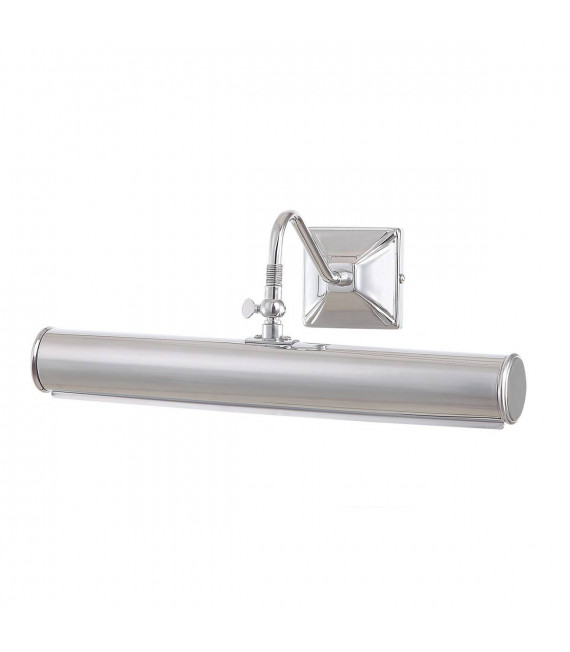
Picture Light wall light in polished chrome, large 36 cm model
In stock
£190
- Height (cm)
- 13.5
- Width (cm)
- 36
- Depth (cm)
- 20
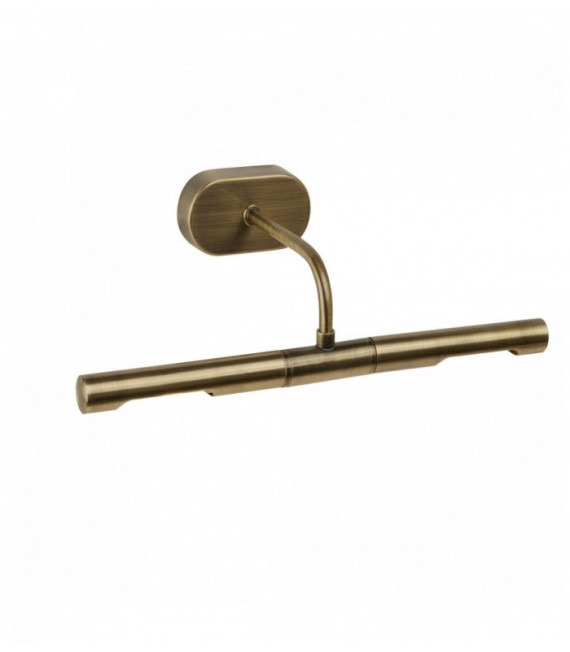
Valencia picture light in antique brass, 35 cm, 2 G9 bulbs
In stock
£59
- Height (cm)
- 10
- Width (cm)
- 35
- Bulbs included
- No
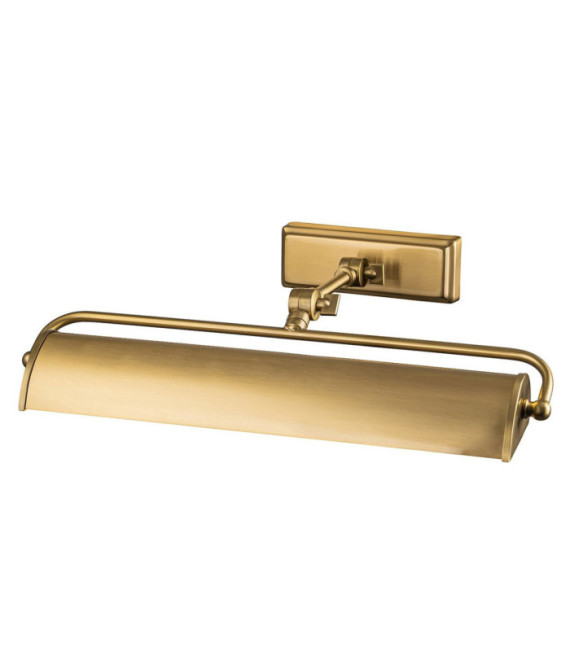
Winchfield picture light, antique brass, 2 lights, 44.5 cm
In stock
£211
- Height (cm)
- 12.7
- Width (cm)
- 44.5
- Bulbs included
- No