Living room lighting has to work for entertaining and for relaxing. Layer ceiling, floor, table and wall lights, then set output and colour temperature.
Planning your living room lighting
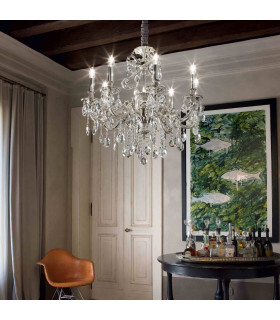
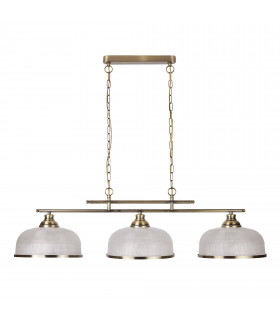
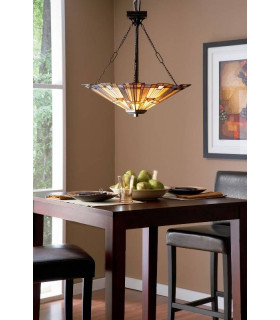
- On the ceiling: a living room pendant light or a living room chandelier gives the space structure. Keep at least 2 m of headroom under the light, ideally 2.10 m; under a ceiling lower than 2.50 m, choose a ceiling light or a short pendant.
- On the floor: a living room floor lamp by the sofa or reading chair, with the light source slightly above and behind your shoulder when seated.
- On the walls: living room wall lights 1.60 to 1.80 m above the floor, either side of a fireplace, a sofa or a bookcase.
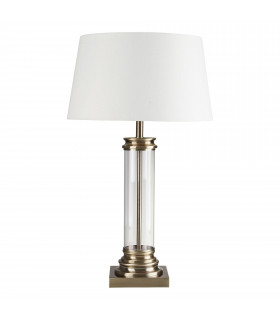
- On furniture: one or two table lamps on a console or side table to light the corners.
Size, output and colour temperature
For a central light, (room length + width in metres) × 8 gives a guide diameter in centimetres: about 70 cm for a 4 × 5 m living room, close to 1 m for 5 × 7 m. Match the total output to 100 to 150 lumens per m², so 3,500 to 5,250 lumens for a 35 m² living room, shared between all the light sources.
Choose a 2,700 K warm white and dimmable bulbs: a dimmer or several circuits let you go from bright lighting for guests to a soft glow.
Styles and materials in the living room
Metal in chrome, gold brass or black dominates, paired with glass, acrylic, fabric and crystal; ceramic, wood, stone and natural fibres warm up a more pared-back interior. Modern and classic styles are the most common, followed by vintage and retro, industrial, Art Deco, rustic and country, and Scandinavian. Our guide to lighting your living room well has more layout ideas, and our lighting by room section covers the rest of the house.
Frequently asked questions about living room lighting
How many light sources does a living room need?
Allow at least three sources at different heights: one on the ceiling, one on the floor and one on a piece of furniture or the wall. A living room over 30 m² often needs five or six, spread by zone: sofa, reading corner, TV unit, bookcase. Together they should add up to 100 to 150 lumens per m².
How do I light a living room without a ceiling light?
Use more secondary light sources. An uplighter floor lamp aimed at a pale ceiling gives indirect light; wall lights 1.60 to 1.80 m above the floor light the walls; table lamps fill the corners. Plug them into switched sockets controlled from a wall switch so everything comes on as you walk in.
What lighting works best around the TV?
Avoid a bright source that reflects in the screen, such as a spotlight aimed at it or a lamp directly opposite. A soft, indirect light in 2,700 K warm white beside or behind the TV unit reduces the contrast with the picture. During a film, dim the ceiling light and keep one lamp on.
Which light suits a living room with a high ceiling?
A large space can take a large-diameter pendant or chandelier, 100 cm or more, or a cluster of pendants hung at different heights. Leave at least 2.10 m under the light where people walk. Wall lights that shine upwards emphasise the height of the walls and stop the ceiling being left in shadow.