This page helps you choose spotlights: type to suit your ceiling, number, light source and IP rating. A recessed spotlight needs a void above the ceiling; on a solid ceiling, choose a surface spotlight, a bar or a track. For the living room, see our living room spotlights; for the bedroom, bedroom spotlights, and more decorative models are under designer spotlights.
Recessed spotlights in a ceiling void: cut-out, depth and number
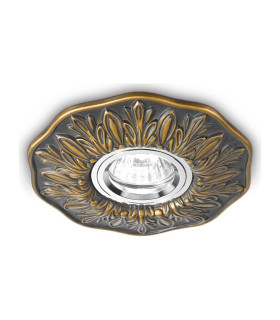
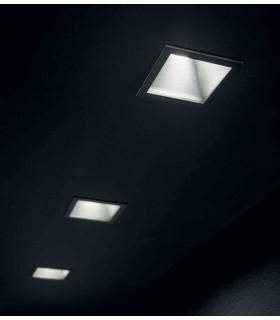
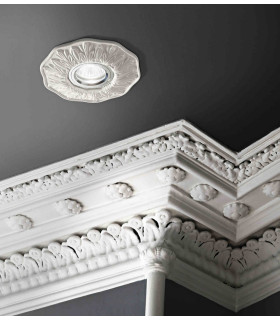
Nothing else disappears into the ceiling. Before you drill, note two figures from the product page: the hole-saw diameter, which you never exceed, and the clear depth behind the bezel. A GU10 needs room in the void. Integrated LED or a GX53 cap gets by with a few centimetres. Leave air around the housing and keep it clear of loft insulation, because an LED that can't breathe ages fast. The recessed spotlights include round and square versions and plaster-in bezels you can paint.
How many recessed spotlights do I need?
Allow one spotlight for every 1 to 1.5 m² of hallway or worktop, at 300 to 500 lumens per spotlight. A 6 m hallway therefore takes four to six of them. Fit one every 1 to 1.5 m and keep them 50 cm from the walls.
On a solid ceiling, surface spotlights, bars or track
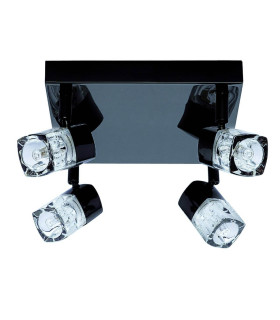
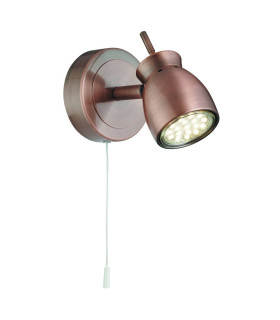
Aim an adjustable head at a wall or a surface, never at a seat. Cleaning is a dry cloth over the reflector, with the power off. The ceiling spotlights give the number of heads, and our guide to lighting small spaces settles recessed versus surface-mounted by ceiling height.
Which spotlights can I fit without a ceiling void?
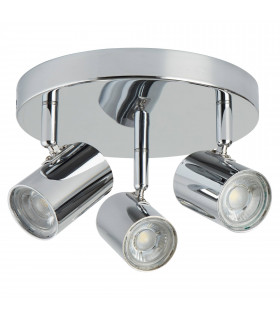
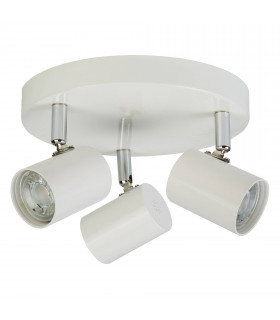
On concrete or under exposed beams, choose a surface spotlight, a bar or a track: a recessed spotlight needs a void.
- A single cylinder comes 20 cm long for an ordinary ceiling and up to 75 cm for a tall stairwell.
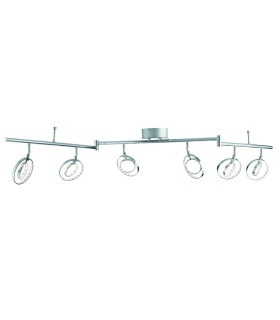
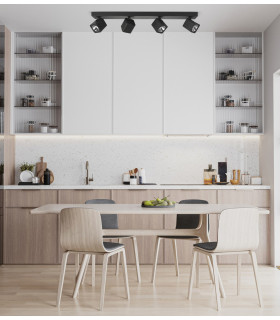
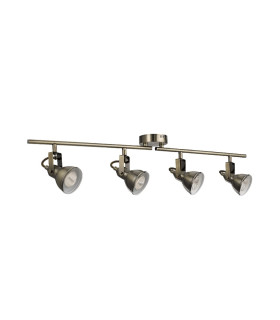
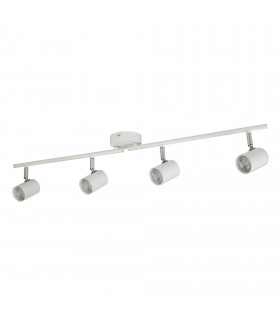
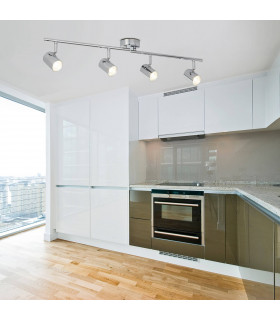
- A bar of three or four adjustable heads connects to the existing ceiling rose and covers a run of kitchen units.
- A track of 1 to 1.50 m carries three to five spots that slide along its length.
The source: cap, colour temperature and dimming
When renovating: old halogen spotlights with GU5.3 or MR16 caps run at 12 V from a transformer, which has to come out before you switch to GU10.
Among the spotlights that state their colour temperature, three in four are warm white, 2,700 to 3,000 K. Keep 4,000 K for a worktop; the "LED light colour" filter picks it out. To dim, the bulb, spotlight and dimmer must all be marked dimmable.
GU10 or integrated LED spotlights: which should I choose?
GU10, which dominates, is a 230 V LED bulb you swap without tools, in the colour temperature of your choice; integrated LED allows recessed fittings only 8 to 9 cm across and lasts 15,000 to 25,000 hours, after which you replace the spotlight itself, so check the rated life on the product page. A few spotlights are supplied with their bulb, and the product name says so; otherwise, you add one. Fittings with a built-in source are under LED spotlights.
IP20 on the living room ceiling, IP44 over the sink, IPX4 over the shower
- Dry room, IP20. That is the great majority of the spotlights on this page.
- Above a kitchen sink, IP44 as a sensible precaution, though nothing requires it in a kitchen.
- Under a canopy or porch, IP44 or IP54. In driving rain, IP65.
The product page gives each spotlight's IP rating. Bathroom circuits need 30 mA RCD protection, and in England and Wales work within the zones is notifiable under Part P. If you have any doubt about a position over a shower, ask an electrician to confirm it.
What IP rating does a spotlight need above a shower or bath?
Above the bath or shower tray, up to 2.25 m (zone 1 under BS 7671), a spotlight needs IPX4 at least, IPX5 where water jets are used. With no tray, the zone reaches 1.20 m out from the fixed shower head. In the 60 cm band around it (zone 2), IPX4 again; beyond that, IP44 is still advisable, and the washbasin creates no zone of its own. The bathroom spotlights are sorted by rating.
By room
See the kitchen spotlights for the worktop and the hallway spotlights for spacing. For a question about a cut-out or a cap, ring +33 1 84 20 32 51, Monday to Friday, 8am to 5pm UK time; delivery is free in the UK and the European Union, and you have 30 days to change your mind.