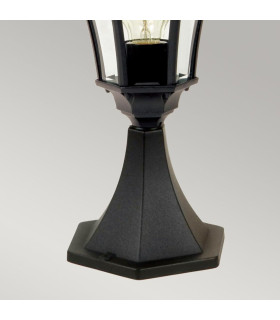
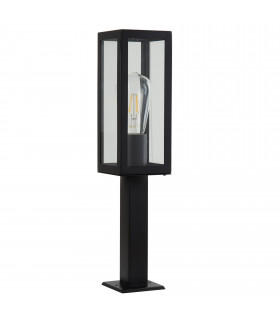
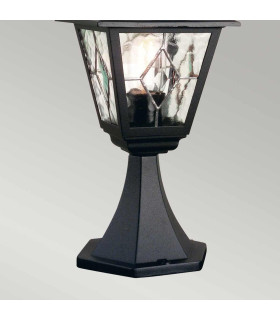
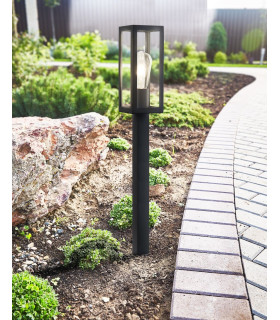
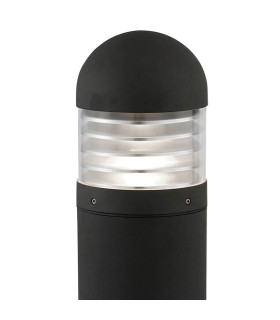
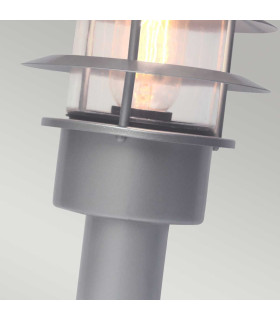
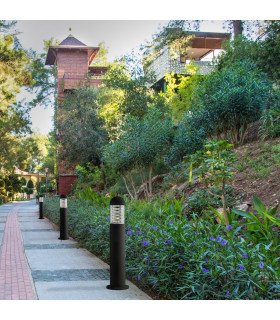
A garden bollard, or outdoor bollard light, marks out a path, a border or a few steps. The garden bollards on this page are black or grey metal, wired to 230 V mains. Solar and 12 V barely feature, so plan the buried cable run first, then the height, then the style.
Bollard light heights
How tall should a bollard be for a path one metre wide?
Allow 40 to 60 cm; 80 to 100 cm for a driveway.
- Under 40 cm. The bollard marks a flower bed or a few steps; it won't light a path.
- 40 to 60 cm. One bollard every 2 to 3 m, on one side only; the best-stocked size here.
- 80 to 100 cm. The taller post for a driveway, one every 3 to 4 m, staggered if the drive is wide.
- Over 1.30 m. You're into garden lamp posts.
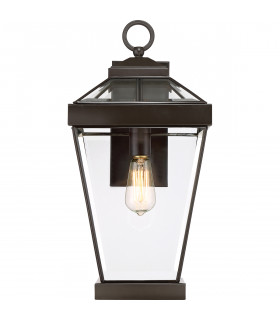
Allow 200 to 500 lumens per bollard, aimed down. Beside a path, a clear-glass lantern dazzles more than a louvred bollard.
Outdoor bollards, IP and IK
IP44 or IP65: which one stands up to rain and the garden hose?
IP65, out in the open garden. More than half the bollards on this page are IP44, a rating for a sheltered spot such as a covered terrace or the foot of a wall under deep eaves. In the open garden, with rain and the sprinkler, take IP65; set into the ground, IP67, the territory of outdoor recessed lights.
IP says nothing about knocks. That is the job of the IK rating: IK08 at least beside a driveway or a gate, ideally with an aluminium body and an acrylic diffuser, both common here. By the sea, take 316 marine-grade stainless steel or powder-coated aluminium.
Mains bollards: cable, fixing, bulb
How do you run the cable, and what does the bollard sit on?
Use cable designed for burial, laid in a protective duct at the depth the wiring regulations require, with warning tape above it and a 30 mA RCD at the consumer unit. Connection is a job for an electrician, and in England and Wales a new garden circuit comes under Part P. Fixing depends on the model: a base plate bolted to a concrete pad for columns and lanterns on a plinth, a base set in concrete for tall posts, a ground spike for lawn spots. The junction box inside the column must stay accessible.
E27 bulb or integrated LED, and what colour keeps the neighbours happy?
Three bollards in four take a standard bulb, mostly E27, with GU10 or G9 in the slim tubes; a 470-lumen LED is plenty. The remaining quarter is integrated LED with a module you can't replace, so compare the stated lifespan, usually 15,000 to 30,000 hours. Stay with warm white. At 2,700 K, with less blue in it, the light bothers the neighbours less and generally draws fewer insects.
Almost no bollard has a built-in sensor. It goes on the circuit, or on the garden wall light by the door. The whole family is under outdoor lighting, and our guide on lighting your garden covers paths along with the front of the house.
To work out how many bollards a path needs, call +33 1 84 20 32 51, Monday to Friday, 8am to 5pm UK time; free delivery in the UK and the European Union, 30 days to change your mind.