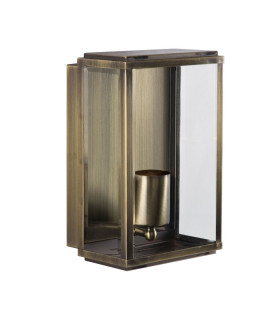
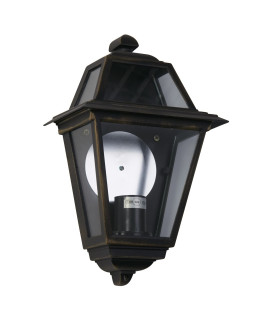
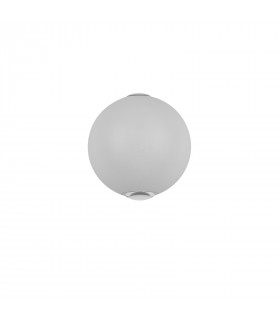
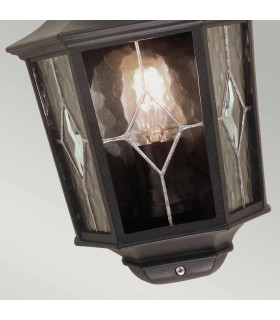
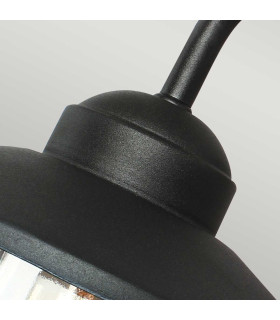
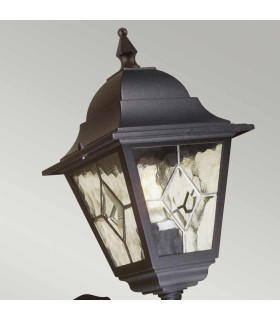
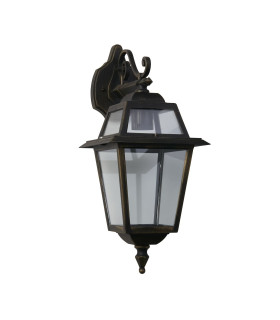
Lantern or up-and-down outdoor wall light? By a front door, the question comes up on every house. A lantern lights the doorstep and is seen from the street; an up-and-down draws on the wall and only shows once lit.
Under a canopy IP44 is enough; on a wall that takes the rain you need IP65
Two in three of these garden wall lights are IP44, the rating for a wall sheltered by a canopy or porch. Exposed to rain, move up to IP65, while IP54 models cope on a wall that sees little weather, under deep eaves. A few lanterns rated IP23 to IP43 belong only under a porch closed on three sides. The "Protection (use)" filter does that sorting. Near a gate, check the IK rating too, IK08 at least.
Outdoor wall light, lantern or up-and-down: the differences that matter
- Light. A lantern diffuses through its panes, clear or seeded, and lights the step. An up-and-down throws two tight cones on the wall and leaves the ground dark between two lights.
- Source. A lantern takes an E27, an 8 to 10 W LED giving about 800 lm, which you change yourself and which is supplied only if the product page says so. An up-and-down is often integrated LED, rated for 15,000 to 30,000 hours, or takes two GU10s.
- Output. 400 to 800 lm by a front door, 300 to 500 lm per light to mark out a patio or a side passage.
- Mounting. Fit a lantern slightly above eye level on the lock side, so callers are not dazzled. An up-and-down needs 60 to 80 cm clear below the eaves, or the upper cone flattens into a hot spot.
- Wall. Grazing light from an up-and-down picks out every bump in pebbledash or render. A lantern lights the wall head-on and smooths it.
- Colour. 2,700 to 3,000 K, light pointing down. Neutral white bleaches faces.
House front and motion sensor
Lantern or up-and-down wall light: which one for which house front?
Choose a lantern for an older house, and whenever the light must also reach the ground in front of the door. An up-and-down suits smooth render, cladding or a boundary wall. A few models of each kind have a PIR motion sensor with a range of 8 to 12 m and an angle of 110 to 180°, to be fitted 2 to 2.50 m above the ground.
Do you need an electrician to wire an outdoor wall light?
There are almost no solar wall lights here. The rest run on mains voltage behind a 30 mA RCD, wired by an electrician.
Path, porch and guide
To light the ground along a path, garden bollards do better than a wall light; under a deep porch, an outdoor ceiling light lights the step without shadows. Built-in LED models are under LED outdoor lighting, everything else under outdoor lighting, and our guide on lighting your garden covers the house front and the path.
If an IP rating or a fitting height leaves you unsure, +33 1 84 20 32 51 answers Monday to Friday, 8am to 5pm UK time; free delivery in the UK and the European Union, and 30 days to change your mind.